Balanced Meals
What a slow week of balanced meals revealed about daily rhythm
Harriet Marsden··10 min read
There is a particular quality to the celeriac that arrives in the markets in late November. Dense, misshapen, unwieldy in the hand — it is not a vegetable that sells itself on appearance. But in the context of what the season offers, it occupies a structural role in the kitchen that no other root can quite replicate. This piece is about that role, and the logic that seasonal produce imposes on the structure of a plate.
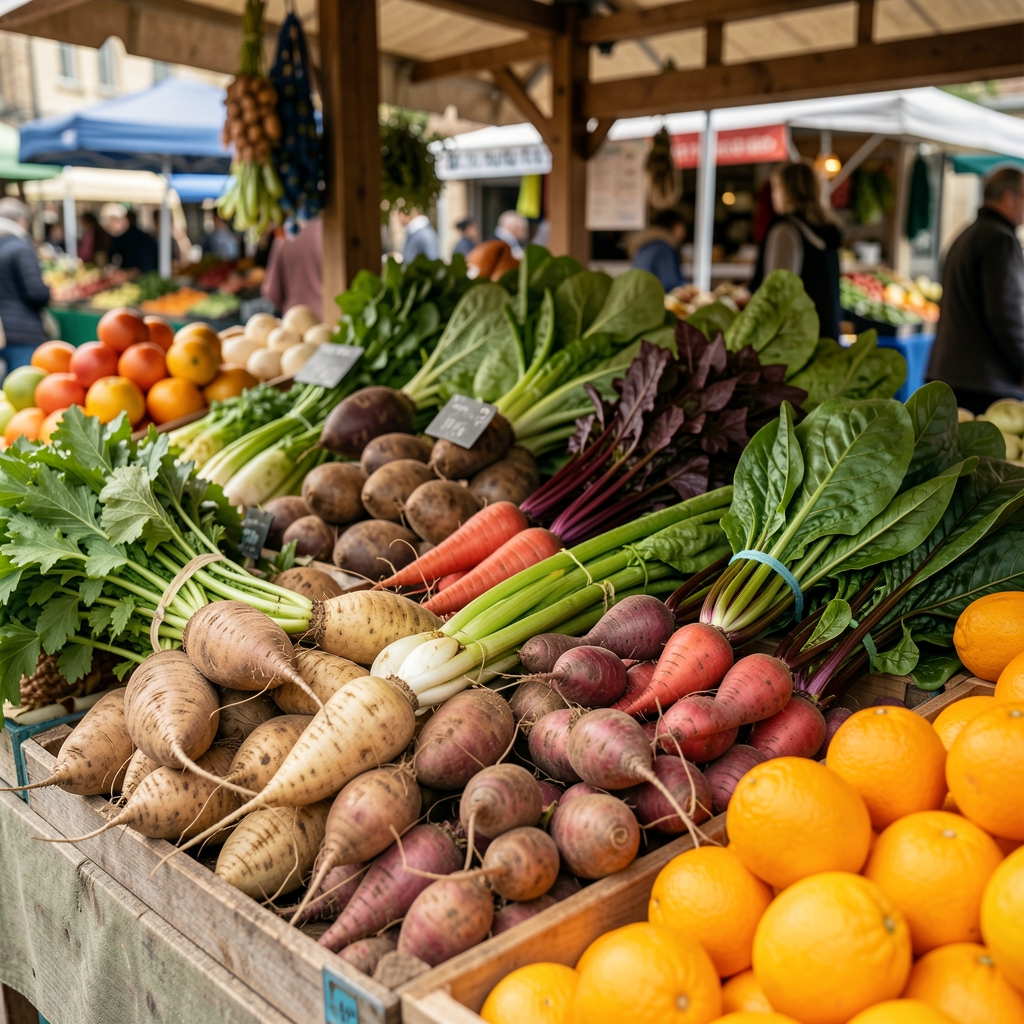
The weekly visit to a produce market — or even a well-stocked greengrocer — functions, for the attentive cook, as something close to a meal-planning session. Not in the sense of working through a list of planned recipes, but in the sense that the available produce imposes a set of structural possibilities that constrain and, in constraining, concentrate choice.
In February, the choice narrows considerably from the abundance of late summer and autumn. What remains is particular and, on examination, extraordinarily suited to cold, slow cooking. Roots: celeriac, parsnip, swede, turnip, beetroot in multiple varieties. Brassicas: purple sprouting broccoli, cavolo nero, savoy cabbage, Brussels sprouts still on the stalk in some markets. Citrus from further south: blood oranges, Seville oranges, clementines finishing their season. Winter squash that has aged into sweetness in storage.
A plate constructed from this list does not require instruction. It assembles itself according to the logic of the season: something roasted, something braised, a green element handled with care, a brightness of acidity. The structure of the plate emerges from the nature of what is available, not from a nutritional model or a recipe template.
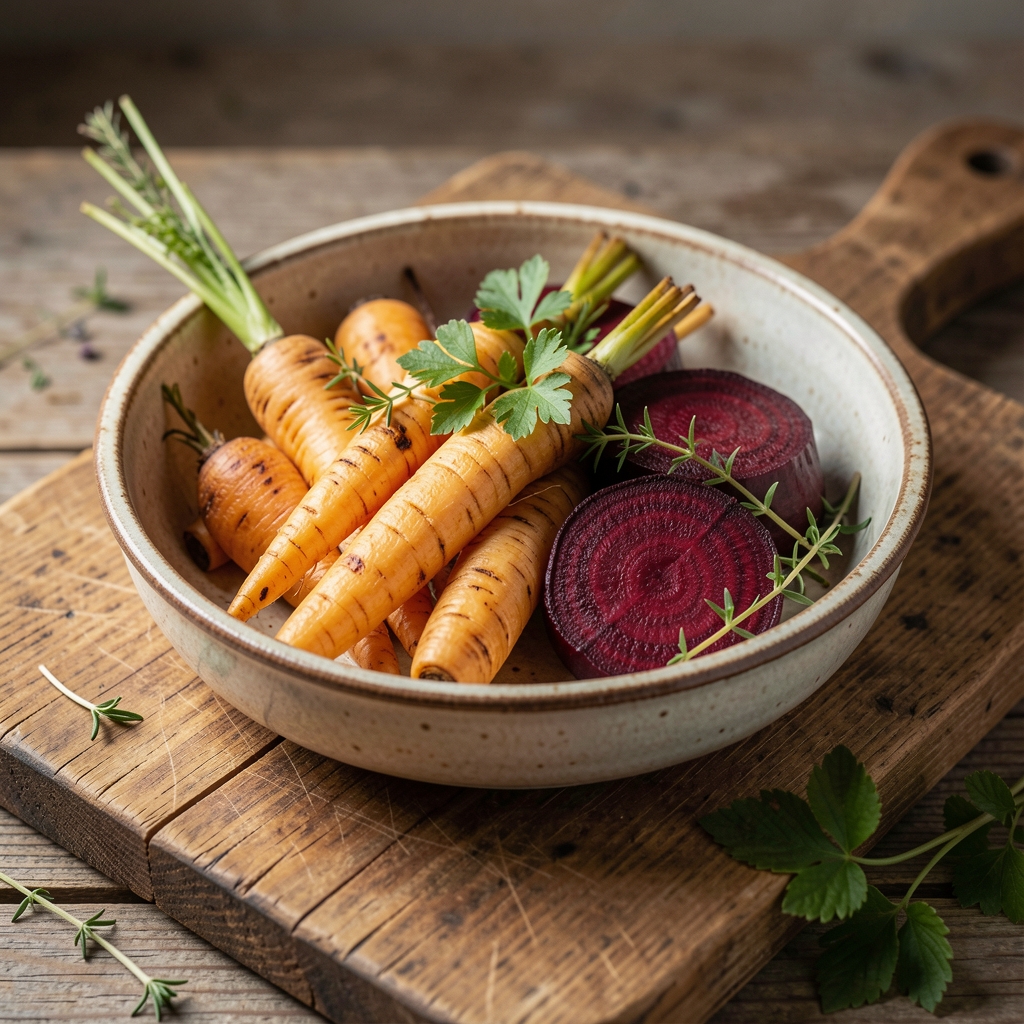
Root vegetables carry a structural property in the meal that is worth naming precisely. They are dense, slow to cook, rich in complex carbohydrates and dietary fibre, and they respond well to the application of heat over time. Roasted at a high temperature, they caramelise and become something almost sweet. Braised slowly in liquid, they absorb flavour and become yielding. The same piece of celeriac, handled differently, produces two entirely different eating experiences.
This structural flexibility is useful for a weekly eating routine. The celeriac bought on Saturday can be used in three different contexts across the week: roasted alongside chicken on Sunday evening, grated raw into a remoulade for Monday's lunch, diced and folded into a slow-cooked white bean preparation for Wednesday. The larder logic described in our previous entry — where ingredients reappear in transformed states across a week — applies here with particular force.
The published literature on dietary fibre and gut function notes that roots and brassicas are among the more reliably fibre-rich food categories in the temperate kitchen. But beyond the nutritional accounting, there is a quality of satiety associated with these foods that the seasonal cook encounters as a practical reality rather than a studied fact. A meal centred on roasted roots and braised greens produces a specific and recognisable kind of fullness — grounded, sustained, without the sharpness of immediate hunger.
If roots provide the structural base of the winter plate, brassicas provide its character. Cavolo nero braised with garlic and olive oil until completely tender. Purple sprouting broccoli steamed and dressed simply with good oil and sea salt. Savoy cabbage shredded and wilted with butter and a splash of white wine. These are preparations that require little technique but considerable attention to timing. Overcooked, brassicas lose their character entirely; timed correctly, they are some of the most satisfying foods the season offers.
The variety available in the February market is striking to anyone who has only encountered these vegetables in their supermarket form. At least six distinct brassica species were available at a stall visited in south London last February, each with a distinct flavour profile and best-use application. The cavolo nero, with its bitter depth, is suited to long braising. The purple sprouting broccoli, delicate and sweet, needs only minutes. The interaction between what is available and how it will be used requires a kind of knowledge that is built through the repeated practice of seasonal cooking.
The season does not offer convenience. It offers coherence. These are different things, and the confusion between them is responsible for a great deal of unnecessary difficulty in everyday cooking.
A winter plate composed entirely of roots and brassicas risks a particular kind of heaviness — satisfying in the body, but demanding in its cumulative effect. The corrective is citrus, and February is, for those who cook seasonally, the high season of citrus variety. Blood oranges, with their deep colour and complex flavour; Seville oranges, intensely bitter and suited to dressings rather than fresh eating; clementines at the end of their season, sweeter than ever.
The structural role of citrus on a winter plate is one of acidity and brightness. A salad of shredded cavolo nero dressed with blood orange juice and good olive oil reads differently from the same salad dressed with lemon alone — the orange brings a depth of flavour alongside the acidity that changes the character of the dish. The combination is one that nutritional analysis would describe in terms of vitamin C content, but that the cook encounters first as a matter of balance and flavour.
Eaten as fruit alongside a meal, citrus fulfils a similar role. A few segments of blood orange alongside a rich root-vegetable preparation introduce a lightness that completes rather than competes. The structure of the plate — dense, yielding, sweet — is resolved by the brightness of the fruit. This is not a rule or a technique; it is a logic that emerges from the nature of what is available and what works together.
One of the quieter conclusions from a season of market-led eating concerns processing. The ingredients encountered at a producers' market arrive, by definition, in their whole and relatively unprocessed states. The celeriac has not been peeled, chipped, and vacuum-sealed. The cavolo nero has not been shredded and packaged. The blood oranges have not been juiced and bottled.
Working with whole foods at this stage of processing introduces a different quality of engagement with the kitchen. The act of peeling, trimming, slicing, and preparing produces a familiarity with the ingredient that affects how it is subsequently used. A cook who has handled a whole beetroot — felt its weight, trimmed its roots, observed its extraordinary colour when cut — will use it differently from a cook who opens a packet of pre-cooked pieces.
This is not an argument for difficulty for its own sake. It is an observation about engagement. The research on attentive eating — the practice of being present with food before and during the meal — is largely focused on the act of eating itself. But the engagement that comes from preparing whole ingredients extends that attention earlier into the process, in ways that affect both the quality of the cooking and the quality of the eating.
Articles published on Darlev Notebook are editorial in nature and reflect the writers' observations on everyday wellness practices. The content is not intended as professional advice, nor as guidance for the management of any specific condition. Readers with specific concerns about their daily routines are encouraged to speak with a qualified wellness professional.