Balanced Meals
What a slow week of balanced meals revealed about daily rhythm
Harriet Marsden
·
·
10 min read
There is a particular quality to a meal eaten without hurry. Not leisurely in the drawn-out social sense — not a dinner party that ends past midnight — but unhurried in the sense of attending fully to the plate in front of you, registering what is there, and pausing between each portion of it. This quality, once noticed, is difficult to un-notice. And yet most of us spend the majority of our eating time somewhere else entirely.
The phrase "portion control" carries an unfortunate register. It suggests restriction — a counting, a limiting, a policing of the appetite. But the practice of attending to serving size is something altogether different. It is, more accurately, a form of conversation with the body: a question asked before reaching for more, a pause between the first and second helping, an honest accounting of what has already been consumed and what the body is actually requesting.
The distinction matters because the emotional quality of restriction and the emotional quality of attention are opposites. Restriction is anxious, anticipatory, defined by what is being withheld. Attention is present, observational, defined by what is actually here. A person who has developed a practised attention to portion size is not the same person as one who is perpetually denying themselves. The former has found a rhythm; the latter is in a constant negotiation.
Published research on eating behaviour has documented a related phenomenon under the study of eating rate — the speed at which meals are consumed. Across a wide body of literature, faster eating is consistently associated with reduced awareness of satiety signals and correspondingly larger total intake. The mechanism is not mysterious: the body's recognition of fullness is not instantaneous. There is a lag — typically estimated at around fifteen to twenty minutes — between the point at which enough has been consumed and the point at which that sufficiency is consciously registered. The hurried eater has often moved well past the useful stopping point before the signal arrives.
Slowing down at the table is more than a strategy for managing intake. It alters the qualitative experience of eating in ways that are, once encountered, immediately recognisable. Flavours that register as background noise when a meal is consumed quickly — the slight bitterness of a braised green, the particular sweetness of a slowly roasted carrot, the mineral sharpness of a good cheese — come forward when the pace allows them to. The meal becomes richer not because anything has been added, but because more attention has been brought to what was already there.
This is the sensory dimension of mindful eating, and it is often underemphasised in practical guidance. The focus tends to land on the cognitive elements — are you hungry before you start? Are you aware of what you are eating? — but the textural, aromatic, and flavour dimensions of a meal are equally part of the practice. A meal eaten with full sensory attention is a more complete experience than the same meal consumed while checking a telephone or reading at the table. It is also, reliably, a more satisfying one.
I first encountered this in a practical sense during a period when my working hours had extended to the point that lunch was consistently compressed into twelve minutes at a desk. The meals themselves were not poor — I had continued to compose reasonable plates. But the satisfaction was absent. Each meal was consumed and immediately forgotten; hunger returned earlier than it should have; the afternoons felt depleted in a way that had no obvious cause. Returning to seated meals, taken without distraction, at a measured pace, resolved these observations within a fortnight.
The most reliable adjustment to a daily eating routine is not a change in what is consumed. It is a change in how present one is during the consuming of it.
There is a useful visual shorthand for constructing a balanced plate that has appeared in various forms in nutrition writing over several decades. Its most durable version involves dividing a standard dinner plate into rough thirds or quarters and allocating those portions to categories of food: a substantial section to vegetables, a moderate section to whole-food carbohydrates, a smaller section to protein-dense foods, and — in many versions — a remaining portion to be filled by whatever the meal requires that day.
The value of this framework is not its precision. It is not a formula that produces optimal outcomes when followed exactly. Its value lies in what it trains: the habit of looking at the composition of a plate before eating it. This single act of observation — pausing briefly before the first bite to register what is there and in what proportion — is, in practice, more consequential than the specific ratios being observed.
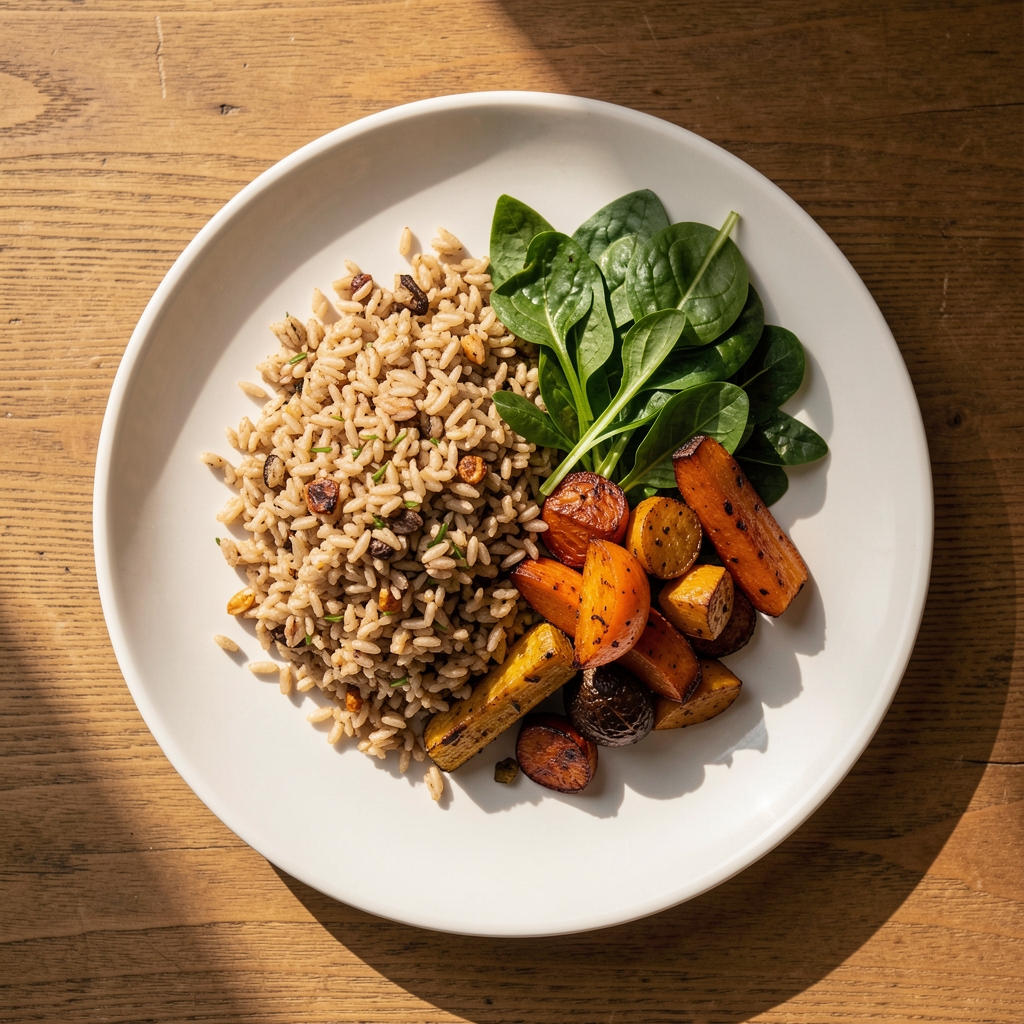
What I have observed in my own practice over several months of attending carefully to this is that the proportion of vegetables on a plate tends to increase without effort when the plate is looked at before eating begins. The act of registration creates a kind of implicit review. If the green section is very small, there is an almost instinctive adjustment — not driven by any nutritional instruction, but by a basic aesthetic sense of what looks right. The visual grammar of a well-composed plate is something most adults have internalised; the difficulty lies not in knowing it but in attending to it.
The relationship between physical activity and appetite is one of the more misunderstood aspects of everyday food practice. The common assumption — that more movement produces more hunger, and therefore that active days require significantly more food — is true in gross terms but misleading as a daily guide. The appetite signals that follow moderate sustained movement are often more calibrated than those that precede it: clearer, more specific, easier to interpret. A person who has spent the morning walking and the afternoon seated at a desk will often find, by evening, that their hunger has a particular quality — not the restless, ambient appetite of an inactive day, but something more directed and easier to satisfy.
Attending to this variation — noting how the quality of appetite differs across different kinds of days — is part of what a long-term practice of portion awareness produces. The goal is not a fixed quantity of food each day, but a flexible and accurate reading of what is actually needed. This is considerably easier to develop than it sounds. It requires, primarily, attention and time — the same resources that any other observational practice draws upon.
Digestive wellbeing and eating pace are connected in ways that have been documented in published research for some time. Thorough chewing, adequate time between bites, and a general unhurriedness at the table create conditions in which digestive processes are not overloaded. The mechanics of this are straightforward: the early stages of digestion occur in the mouth, and the speed of that early processing influences the demands placed on subsequent stages. A meal consumed quickly arrives in the stomach as a more concentrated and less prepared mass.
Gut-friendly recipes — the fermented staples, the fibre-forward preparations, the whole-grain bases that appear frequently in contemporary food writing — perform a fraction of their function when consumed in haste. The quality of ingredients and the quality of attention to those ingredients are complementary. One without the other is incomplete.
This is the simplest argument for slowing down at the table: not that it is morally better, not that it produces measurable outcomes in every individual, but that it allows the food being eaten to be what it is. A meal made with attention to its ingredients, consumed with attention to its presence on the table, is the full version of eating. The half-version — good food, poor attention — produces the half-experience: adequate nourishment, minimal satisfaction, and a faint but persistent sense that something was missed.
Articles published on Darlev Notebook are editorial in nature and reflect the writers' observations on everyday wellness practices. The content is not intended as professional advice, nor as guidance for the management of any specific condition. Readers with specific concerns about their daily routines are encouraged to speak with a qualified wellness professional.